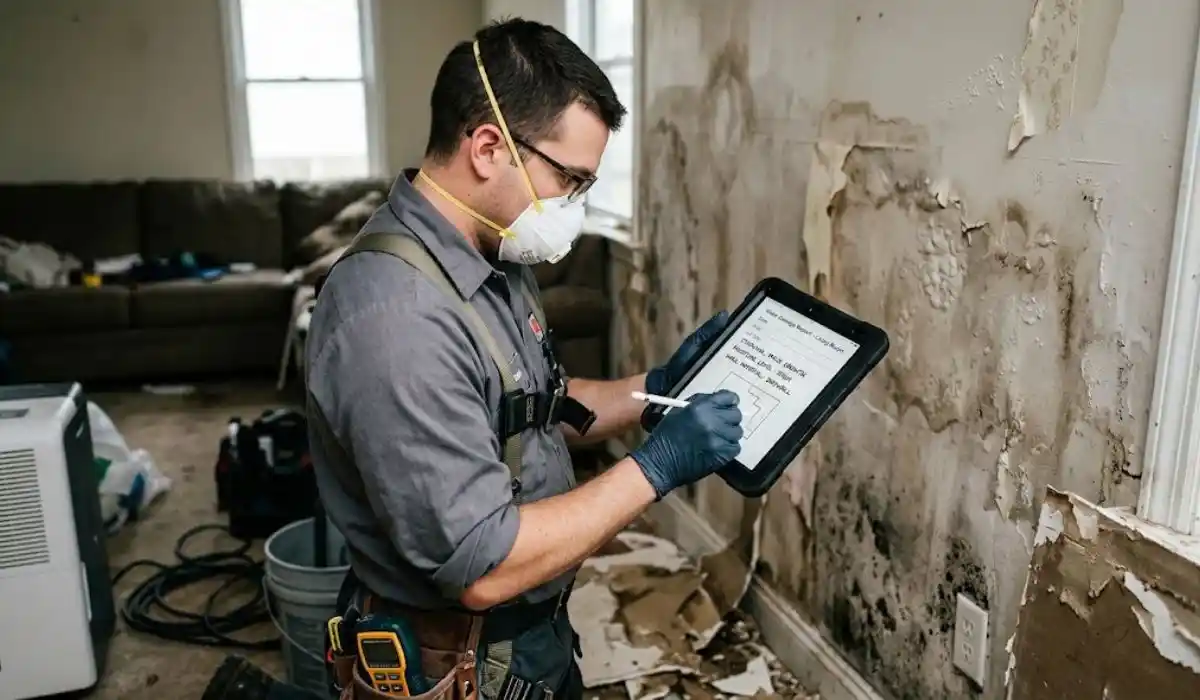
Two separate insurance gaps affect an Islip homeowner with a flooded basement, and most people only discover the first one after it is too late to matter. The first gap: a standard homeowner's HO-3 policy, the kind nearly every mortgage lender requires, specifically excludes flood damage. Flood, in insurance terms, means water entering from an outside source, storm surge, overland runoff, an overflowing water body, rather than water that originated inside your own plumbing. A burst pipe is typically covered under a standard homeowner's policy. Bay water pushed into your basement during a nor'easter is not, and requires a completely separate flood damage restoration claim path through a flood policy, usually through FEMA's National Flood Insurance Program or a private flood carrier.
That much is at least widely known, if not always acted on before a storm rather than after one. The second gap is less understood, and it catches even homeowners who did the right thing and purchased flood coverage: NFIP flood insurance itself defines what counts as a covered basement item very narrowly.
What NFIP Basement Coverage Actually Includes
FEMA defines a basement, for flood insurance purposes, as any area with a floor below ground level on all sides. That definition sweeps in more than people expect, including sunken living rooms and the lower level of some split-level homes, not just a traditional below-grade basement.
Under building coverage, items connected to power and permanently installed are covered if they take flood damage: central air conditioning units, furnaces and water heaters, electrical outlets and wiring, and sump pumps. Under contents coverage, which has to be purchased separately from building coverage and is not automatic, a narrower list applies: clothes washers and dryers, freezers and their contents, and window air conditioning units, again only if connected to a power source.
What's Explicitly Not Covered
Everything else in a basement is excluded from a standard NFIP policy, and the exclusion list is exactly what a finished basement tends to be full of. Finished-basement improvements, drywall, paneling, flooring beyond a basic unfinished slab treatment, are not covered. Furniture is not covered. Televisions are not covered. Family photographs and keepsakes are not covered. The policy will also not pay to remove non-covered items even when removing them is necessary to reach and repair covered building components, which means the cost of clearing out ruined carpet to get at the subfloor underneath can land entirely on the homeowner.
For an Islip basement that has been finished as a den, a home gym, or additional living space, this means flood insurance, even when purchased and in force, may reimburse the furnace and the electrical system while leaving the drywall, flooring, and everything stored down there entirely uncompensated.
What This Means Practically
Documentation before a loss matters more here than with most insurance situations, precisely because coverage is so item-specific. FEMA's own guidance recommends photographing and recording the manufacturer, model, and serial number of basement equipment, furnaces, water heaters, air conditioning units, before a flood event, since adjusters require this information during a claim and it is far easier to gather in advance than to reconstruct afterward.
It also means the calculation for whether to finish a basement, or how to finish one, in a flood-prone part of Islip is different from the calculation elsewhere. Moisture-resistant materials and a design that keeps the most valuable finishes and storage above the point where recurring flooding actually reaches, worked out during a structural drying and rebuild scope, can meaningfully reduce what ends up in the uncovered category the next time water gets in, regardless of what your policy does or doesn't reimburse.
The Confusion Between Flood And Water Damage Coverage
A meaningful share of the confusion here comes from homeowners conflating "flood insurance" with "water damage coverage" generally, when the two overlap only partially. A standard HO-3 homeowner's policy does cover sudden, accidental water damage originating inside the home, a burst pipe, a failed water heater, an overflowing washing machine, treating it as a named or open peril depending on the specific policy language. What it excludes is water entering from an external source: storm surge, overland runoff, a body of water overflowing its banks. Gradual leaks and long-term seepage are frequently excluded from standard coverage too, on the theory that ongoing, unaddressed moisture is a maintenance issue rather than a sudden loss.
This means an Islip homeowner can genuinely need two entirely separate policies, and sometimes three counting a sewer backup endorsement, to have real coverage against every plausible source of basement water in this area. A property owner who assumes their standard homeowner's policy handles "water damage" broadly is very likely to discover the gap at the worst possible time, mid-claim, after a bay-surge event that a standard policy was never going to cover in the first place.
What To Actually Verify Before The Next Storm Season
Pull your current policy and check specifically whether it includes flood coverage as a separate rider, or whether you have no flood policy at all, which remains common even in mapped surge zones since flood insurance isn't universally required unless a federally backed mortgage mandates it. If you do have an NFIP or private flood policy, confirm whether you purchased contents coverage separately, since building coverage alone leaves everything not permanently installed and powered entirely at risk. And regardless of what's in place, photograph and record serial numbers on major basement equipment now, while there's no active emergency pushing you to skip the step.
A Reasonable Annual Checklist
Once a year, ideally before hurricane season begins in late spring, review your flood policy status and coverage limits, confirm whether contents coverage is included or would need to be added separately, and update your equipment photo and serial number records if anything has been replaced. This is a fifteen-minute task that most homeowners never do until they're mid-claim wishing they had, at which point the information is far harder to reconstruct than it would have been to simply record in advance.
If you rent rather than own in a flood-prone part of Islip, note that a landlord's flood policy, where one exists, covers the building only, never the renter's own belongings, which makes a separate renter's contents policy worth pricing out directly rather than assuming the landlord's coverage extends to you.