More than 70 percent of Suffolk County relies on cesspools and septic systems rather than municipal sewers, a detail that shapes nearly every sewage cleanup call our crews take, a infrastructure reality that came up directly during discussion of the county's response to the record August 2024 rainfall event, when officials pointed to it as part of why certain areas struggle more than sewered communities during major storms. That statistic matters for understanding sewage backup risk here in a way it wouldn't in a more uniformly sewered county, because it means the two most common backup mechanisms, municipal line surcharge and septic system failure, are both live possibilities depending on which part of Suffolk County a property sits in.
The Two Mechanisms, And Why They're Different
In areas connected to municipal sewer lines, heavy rain can cause what's called surcharge: the sewer system, sized for a certain flow capacity, receives more volume than it can handle during extreme rain, and in some configurations that excess backs up through connected properties' own lines rather than reaching the treatment plant. This is more common in older infrastructure, and combined sewer systems that handle both sanitary waste and stormwater in the same pipes are especially prone to it, since a heavy rain event floods the system with stormwater volume on top of its normal sanitary load.
Septic and cesspool systems fail differently. A septic system relies on a drain field with a finite absorption capacity, and during periods of sustained heavy rain, the surrounding soil can become saturated to the point where the drain field simply cannot accept any more effluent, regardless of whether the tank itself is functioning correctly. When that happens, wastewater has nowhere to go but back up the line it came from, surfacing at the lowest drain in the house, which is very often a floor drain in a basement utility area.
Recognizing Which One You're Dealing With
A septic-related backup often comes with warning signs beforehand: slow drains throughout the house in the days leading up to a full backup, gurgling sounds from fixtures as air displaces in a system nearing capacity, or unusually lush, green patches of grass over the drain field area, another sign the ground is oversaturated and effluent is surfacing there instead of absorbing properly. A municipal surcharge backup tends to arrive more suddenly, correlating tightly with the timing of the heaviest rain, and often affects multiple neighboring properties on the same line simultaneously rather than being isolated to one house.
Why Category 3 Water Changes The Response
Restoration professionals classify water by contamination level, and sewage backup cleanup addresses Category 3, the most contaminated classification, carrying bacteria and pathogens that pose a genuine health risk rather than just property damage. This classification is what drives the entire response protocol. Porous material that contacted Category 3 water, carpet, carpet pad, drywall up to the affected waterline, cannot be reliably sanitized and is generally removed and disposed of rather than dried and kept, a very different approach from how a clean supply-line leak would be handled in the same space.
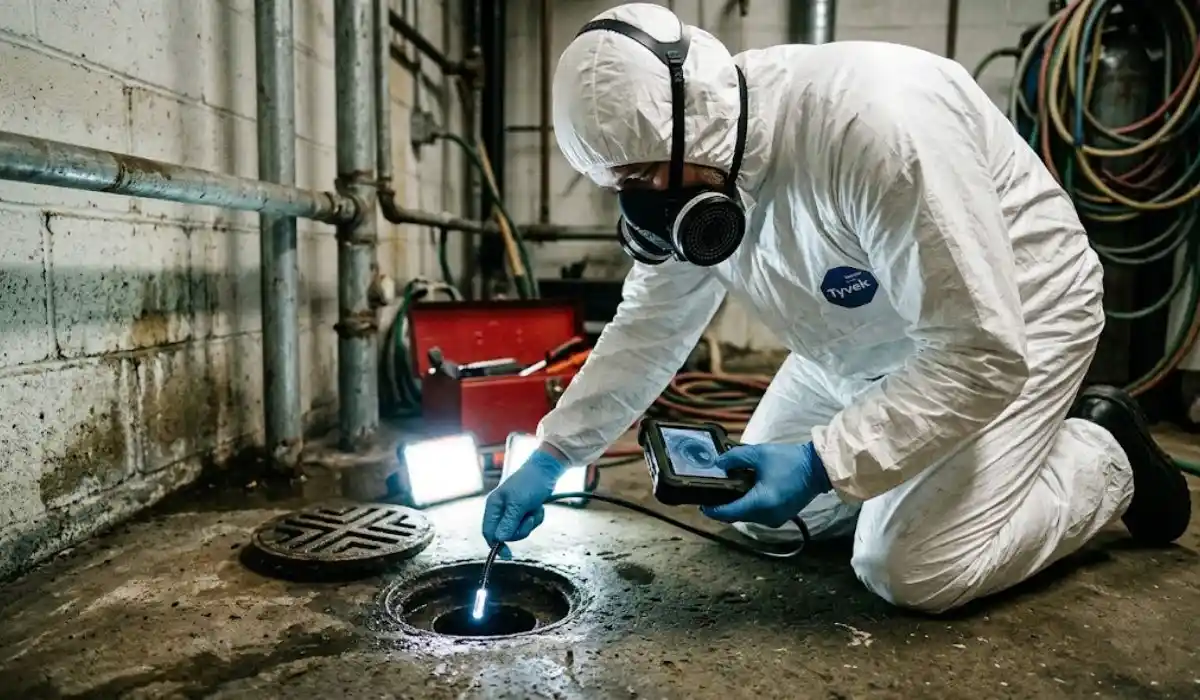
Keep people and pets away from the affected area until professional extraction, cleanup, and sanitizing is complete. This is not an overcautious recommendation; it reflects the genuine contamination risk involved, and it's the same reason technicians handling this type of cleanup work in full protective equipment rather than the lighter gear used for a clean-water job.
What Homeowners Can Do
For septic-served properties, having the system inspected and pumped on a regular schedule, and being especially attentive to slow-drain warning signs during extended wet periods, reduces the odds of a full backup during the next major rain event. For properties on municipal sewer lines in older parts of the county, a backwater valve installed on the main line can prevent surcharge-driven backflow from reaching your fixtures even when the municipal system itself is overwhelmed.
Regardless of which system serves your property, a backup that has already happened needs professional cleanup rather than a homeowner attempting it directly, given the contamination involved. Documentation for insurance purposes should happen before cleanup begins wherever it's safe to do so, since sewer backup coverage is frequently a separate endorsement rather than a standard part of a homeowner's policy, and the claims process benefits from clear documentation of what happened and when.
Why The August 2024 Event Matters Even Though It Hit The North Shore
The record rainfall that devastated Stony Brook, Smithtown, and Brookhaven in August 2024 was a North Shore event, not a direct hit on Islip, but the county-wide infrastructure reality it exposed applies just as much here. That storm delivered close to ten inches of rain in a matter of hours, a 1-in-1,000-year rainfall event, and it overwhelmed drainage and septic capacity across a wide swath of the county regardless of which specific town took the worst of it. More than 2,000 residents and business owners countywide reported flood damage, and the event pushed the state to deploy Department of Financial Services staff specifically to help residents navigate insurance questions in its aftermath.
The lesson for Islip homeowners isn't that this exact storm will repeat here. It's that Suffolk County's septic-heavy infrastructure has a documented capacity ceiling, and when a storm exceeds it, the failure mode is widespread rather than isolated to one neighborhood. A property's own septic system might be well-maintained and still back up during a county-wide event of that scale, simply because the surrounding ground has nowhere left to absorb water regardless of how well any individual system is functioning.
What A Realistic Maintenance Schedule Looks Like
For a typical single-family septic system, professional inspection and pumping on a two-to-three-year cycle is a reasonable baseline, though household size and water usage shift that timeline. Properties that have experienced slow drains or any backup symptoms benefit from a shorter interval and a conversation with a septic professional about whether the drain field itself needs evaluation, since a tank that's pumped on schedule can still back up if the field beneath it has lost absorption capacity over the years.