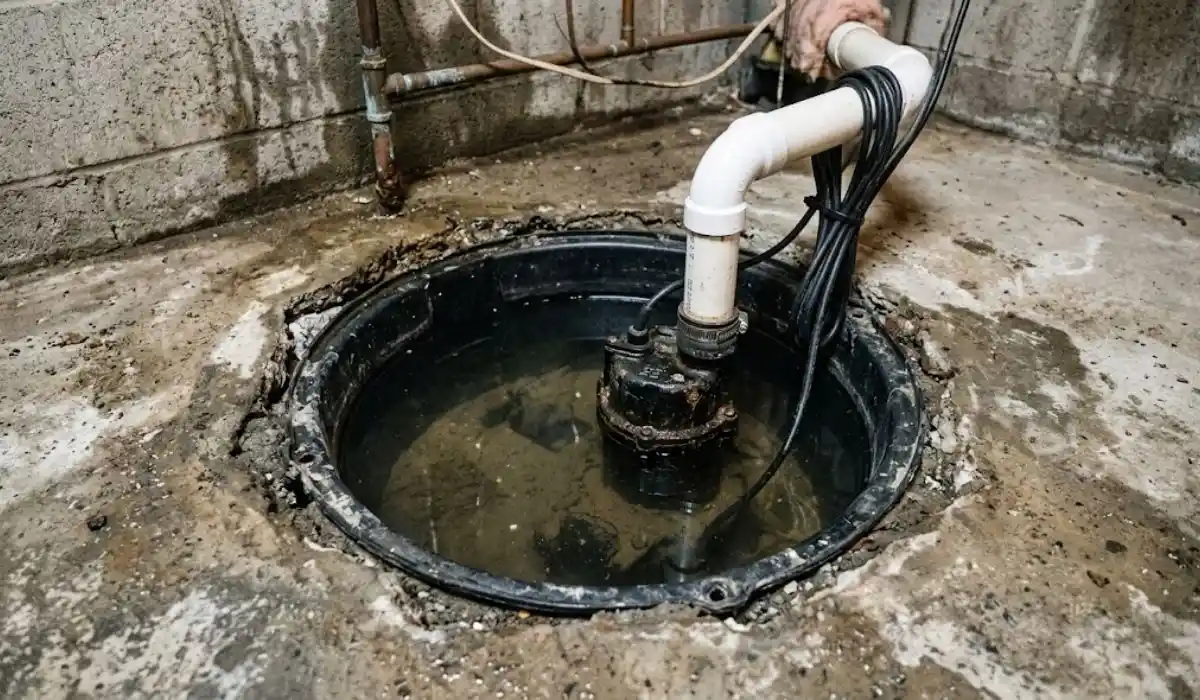
Basement flooding on Long Island tends to come from one of two directions, and they are easy to tell apart once you know what to look for, even though the puddle on the floor looks identical either way. One is a sump pump that failed to keep up with or stop groundwater and rainwater entering through the foundation. The other is a plumbing failure inside the house, a burst supply line, a failed water heater, a washing machine hose letting go. The distinction is not academic. It changes whether you need a plumber, an electrician, or neither before a restoration crew can even start.
Signs You're Looking At Sump Failure
Water from a failed sump system tends to show up at the low point of the basement first, often right around the sump pit itself, and it tends to be clear or slightly murky rather than obviously dirty. It usually correlates with weather: the flooding started during or right after a heavy rain, and if you check the sump pit, either the pump is not running when the float rises, or it is running but visibly not keeping pace with incoming water.
A dead pump during a power outage is the most common version of this. Long Island loses power reliably during significant storms, and a sump pump on standard house current stops the instant the grid does, regardless of how much rain is still falling or how high the water table has risen. If your outage started before the flooding did, that sequence alone is a strong signal.
A second version is a pump that has power but has simply failed mechanically, worn out, jammed with debris, or undersized for the volume of water actually arriving. This tends to happen independent of an outage and is often discovered because the float switch is cycling but nothing is moving.
Signs You're Looking At A Plumbing Leak
Plumbing failures usually announce themselves at a specific fixture or wall rather than at the basement's low point generally. Water tracking from one wall, pooling under a laundry connection, or spreading from around a water heater points toward the house's own systems rather than groundwater intrusion. Weather is often irrelevant. A supply line can fail on a dry, sunny day just as easily as during a storm, which is itself a useful clue: sudden flooding with no recent rain points strongly toward plumbing rather than sump failure.
Freeze-thaw season adds another version specific to this region. A pipe that cracked during a hard freeze sometimes does not leak visibly until the ice inside it thaws, which means the flooding can start well after the cold snap that actually caused it, sometimes days later once temperatures rebound.
Why It Matters Which One You Have
A sump failure during an active storm is often, unfortunately, going to keep happening until either power returns or the storm passes, since there is frequently nothing to physically stop groundwater from continuing to arrive. The immediate priority is getting a working pump back in place, whether that means a generator, a battery-backup unit, or in worse cases a portable pump run temporarily, while extraction of whatever has already accumulated proceeds in parallel.
A plumbing leak, by contrast, can usually be stopped completely and immediately by shutting off the main water valve, after which a water extraction visit addresses whatever already reached the floor, after which the flooding does not get worse regardless of what the weather is doing. That makes the first move very different: shutting off water access is the single most useful thing a homeowner can do before help arrives for a plumbing failure, and it is a step that does nothing for a sump-related flood.
If you genuinely cannot tell which one you are dealing with, treat it as a plumbing failure first, since shutting off the main valve costs nothing and rules out one entire category of ongoing damage while you sort out the rest.
A Third, Less Common Possibility
Occasionally what looks like a sump or plumbing failure is actually a sewer or septic backup, and it's worth ruling out specifically because the response is so different from either of the other two. The tell is usually smell and location: backup water tends to surface at the lowest drain in the house rather than pooling generally, and it carries a distinct odor that clean water, whether from a sump failure or a plumbing leak, does not. If you notice that specific combination, treat the water as contaminated regardless of volume, and avoid direct contact with it while arranging professional cleanup.
What To Check While You Wait For Help
If you've determined it's a sump issue during an active storm, check whether the discharge line outside the house is clear and not simply recirculating pumped water back toward the foundation, a surprisingly common issue that makes an otherwise working pump look like it's failing to keep up. If it's a plumbing leak and you've shut off the main, check whether any fixtures still have standing pressure, since a partially closed valve sometimes leaves enough residual flow to keep a leak going at a reduced rate rather than stopping it completely.
Either way, photograph the affected area and the source if you can identify it, before any cleanup begins. That documentation matters regardless of which failure type you're dealing with, and it's much easier to capture in the moment than to reconstruct once things are already drying out.
Why This Distinction Also Matters For Your Neighbors
A sump-driven flood is usually isolated to your own property, tied to your own equipment and your own soil conditions. A plumbing leak is similarly isolated. But if several neighbors on the same block report basement water at the same time during dry weather with no storm involved, that pattern points toward something else entirely, a shared municipal line issue or a localized water main problem, worth reporting to the water utility directly rather than assuming it's a coincidence of several individual home systems failing simultaneously.